
Skip to content ↓
Home page

Bexley Grammar School

  • Home
  • Our School
    • Our Values and Vision
      • Aims
      • School Prospectus
      • Specialisms
    • Developing Compassionate Leaders
      • Academic Council
      • Environmental Action Group
      • House System and Captains
      • Jack Petchey Achievement Award
      • Peer Mentors
      • Prefects
      • School Council
    • Opportunities at BGS
    • Celebrating Diversity and Inclusion
      • Afro-Caribbean Society
      • Anti-Racism
      • Balkan Eastern European Society
      • EmpowHer
      • SEND
    • Our Community
      • Alumni
      • Governance
      • Parents' Association
      • Penhill Academies Trust
      • BGS Websites
    • Wellbeing
      • BGS Wellbeing Wall
      • Support for Parents/Carers
      • Support for young people
      • WELLBEING NEWSLETTER ARTICLES
    • Ofsted
    • Examination Results
  • Information
    • Term Dates
    • School Life
      • School Opening Hours
      • School Uniform
      • Code of Conduct
      • School Canteen
      • Co-Curricular Clubs & Opportunities
    • Facilities
      • Library
    • Support for disadvantaged students
      • Pupil Premium
      • Free School Meals
      • Free 11+ Familiarisation Materials
    • School Fund
    • Policies
    • Statutory Information
    • Safeguarding
      • Safeguarding during closures
      • Safeguarding Updates
  • Teaching & Learning
    • Curriculum Journey
      • KS3
      • Year 9
      • KS4
    • Subjects
      • Art
      • Classics
      • Computer Science
      • Design Technology
      • Drama & Theatre Studies
      • Economics & Business
      • English
      • Faith, Belief, Culture & Society
      • Geography
      • History
      • Mathematics
      • Modern Languages
      • Music
      • Physical Education
      • PSHCE
      • Psychology
      • Science
    • Careers
    • STEAM (formerly STEM)
      • STEAM Newsletter Articles
      • STEAM PHOTO GALLERY
      • STEAM Scientific Reviews & Recommendations
    • PTI Mark
  • Sixth Form
    • Year 12 Admissions
      • Sixth Form Bursary
      • Life Skills and Policies
    • A LEVELS
      • ARTS
      • ENGLISH
      • HUMANITIES
      • LANGUAGES
      • MATHS AND FURTHER MATHS
      • SCIENCES
      • EXTENDED PROJECT QUALIFICATION
    • The IB
      • What is the IB?
      • Creativity, Activity, Service (CAS)
      • Extended Essay
      • Theory of Knowledge (ToK)
      • Curriculum Statement
    • Post-18 Destinations
      • Comments from BGS students
      • Comments from our parents
    • FAQs
    • Sixth Form News
    • Sixth Form Gallery
  • News & Events
    • LATEST NEWS
    • E Newsletters
      • E newsletters
    • School Magazine
    • Examination News
    • Letters Home
    • Calendar of Events
  • Join Us
    • Admissions
      • Admissions Consultation
      • Admissions Policies
      • Admissions FAQs
      • Appeals
      • Ask the Headteacher
      • Free 11+ Familiarisation Materials
      • In-Year Admission
      • Supplementary Form
      • The Bexley Selection Test
      • Waiting List Year 7
    • Vacancies
      • Teaching Staff Vacancies
      • Support Staff Vacancies
      • Senior Leadership Vacancies
      • Registration of Interest
    • Contact Us
  • PA Facebook
  • Alumni Facebook
  • Archived Content
  • Physics

Physics

physics hl

Physics is the most fundamental of the experimental sciences, as it seeks to explain the universe itself from the very smallest particles - currently accepted as quarks, which may be truly fundamental - to the vast distances between galaxies.

Physics will help you to build up your problem solving, research, and analytical skills. With these skills you’ll be able to test out new ideas plus question and investigate other people’s theories, which is useful for any kind of job that involves research or debate.

We require students to have obtained at GCSE level a grade 7, 7 in the Combined Science Award or ‘7’ in the Physics Separate Science Award. The main distinction between IB and GCSE, apart from the difficulty of the material in terms of the underlying concepts involved, is the emphasis which is placed on your own role in the learning process. As much as anything else, the IB course is trying to prepare you for University life, both academically and in terms of the learning process.

You have not allowed cookies and this content may contain cookies.

If you would like to view this content please

Course description

As one of the three natural sciences in the IB Diploma Programme, physics is concerned with an attempt to understand the natural world; from determining the nature of the atom to finding patterns in the structure of the universe. It is the search for answers from how the universe exploded into life to the nature of time itself. Observations are essential to the very core of the subject. Models are developed to try to understand observations, and these themselves can become theories that attempt to explain the observations. Besides leading to a better understanding of the natural world, physics gives us the ability to alter our environments.

DP physics enables students to constructively engage with topical scientific issues. Students examine scientific knowledge claims in a real-world context, fostering interest and curiosity. By exploring the subject, they develop understandings, skills and techniques which can be applied across their studies and beyond.

Integral to the student experience of the DP physics course is the learning that takes place through scientific inquiry both in the classroom and the laboratory.

IB Physics falls within group 4. You will be externally assessed at the end of the course on the following theory topics at Higher level

PHYSICS SYLLABUS CONTENT OVERVIEW
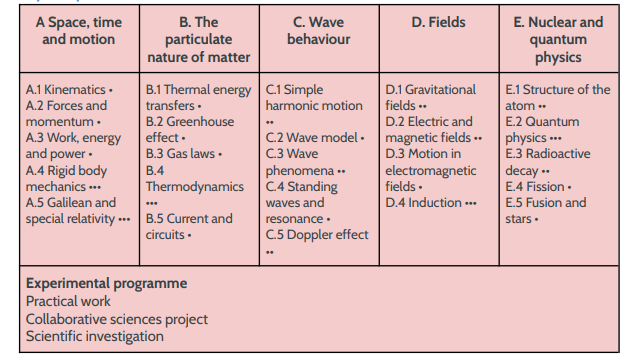
• Topics with content that should be taught to all students

•• Topics with content that should be taught to all students plus additional HL content

••• Topics with content that should only be taught to HL students

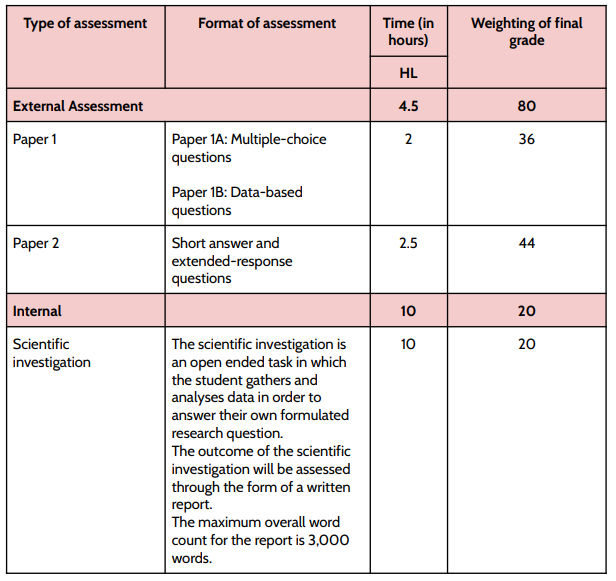
ASSESSMENT OUTLINE 
EXPERIMENTAL PROGRAMME

The IB has a strong focus on practical skills. Students at higher level are required to spend 60 hours on practical work.

Students are assessed on a scientific investigation which they design, carry out and evaluate. This counts towards 20% of your final grade. 

The IB programme also includes a collaborative sciences project which is an interdisciplinary science project addressing global issues. This typically takes 10 hours of timetabled time and results in a presentation of findings and self-reflection on your contribution to the process. The exercise should be a collaborative experience where the emphasis is developing skills in team building, negotiation and leadership.

ENRICHMENT OPPORTUNITIES

STEM enrichment opportunities

  • Physics Olympiad
  • Physics in Action
  • Engineering club
Further Study 

Studying physics opens up a range of opportunities in further education and in career paths in the following: engineering, medicine, law, banking, TV production, architect, computer programming.N.B. this list is by no means exhaustive and further information should be obtained from the School’s Careers Advisers.

The mathematical content, as well as the key communication and problem solving skills, developed during IB & degree level usually make it highly regarded by most university admissions officers and employers.

Developing
Compassionate
Leaders

  • IB
  • The Prince
  • Science
  • Language Colleges

© 2026 Bexley Grammar School | Website design by e4education | High Visibility Version | Accessibility Statement | Sitemap | Privacy Policy | Cookie Settings

Cookie Policy

This site uses cookies to store information on your computer. Click here for more information