
Stephen Spender Trust ~ Prize for Translation

Back in July 2025, pupils from all year groups were invited to take part in the Stephen Spender Prize for Translation run by the Stephen Spender Trust.
This organisation is inspired by the cultural activism of Stephen Spender, poet and champion of international literature. It celebrates multilingualism and literary translation through a range of initiatives and each year it runs a Prize for Creative Translation.
Entrants are challenged to translate into English any poem from any language – ranging from Arabic to Urdu, from Japanese to Russian. It can be a poem, rap lyrics, spoken word or slam poetry with an emphasis on creative rather than literal translation. Entrants are also invited to write a 300 word commentary on their translation, detailing the stylistic decisions they made.
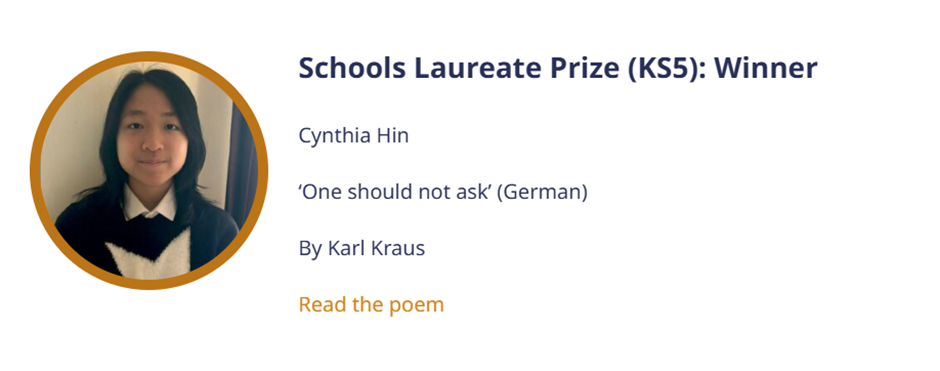
Eight pupils from BGS entered the competition in a variety of languages and at different levels. We would like to congratulate Cynthia Hin in Year 13, who was one of the 3 winning entries in the KS5 category nationally.
Please read Cynthia’s account of the whole process below where you can also see her winning translation. Aditi in Year 8, also took part and has told us a little about her experience too.
Well done to Cynthia and all the entrants. It was fantastic to see language being used so creatively and thoughtfully.
Mrs Watkins, MFL Department
The celebration event was great! At the beginning, the judges were introduced, who then went on to talk about what stood out to them in the poems they read. They played the videos of the winners reading their poems out loud and why they chose that specific poem to translate. I found it really interesting to hear the winners read their translated poems and hear about their thought processes behind the translations, especially since translating poetry specifically can be quite difficult.
When I translated my poem, I first read it a few times in its native language (German) in order to understand what it was trying to convey. In this case, I interpreted it as regret or silence. With this in mind, I roughly translated the poem, aiming to get the key themes down before rewriting it but in a way which I feel more accurately portrays the meaning of each word, whilst also maintaining a poetic style, for example rhyming, which the original poem also used.
Overall, I found the translation challenging at times but also quite fun to do, because translating isn't just literal, but a creative process too.
Cynthia Hin, Year 13
Man frage nicht - Karl Kraus
Man frage nicht, was all die Zeit ich machte.
Ich bleibe stumm;
und sage nicht, warum.
Und Stille gibt es, da die Erde krachte.
Kein Wort, das traf;
man spricht nur aus dem Schlaf.
Und träumt von einer Sonne, welche lachte.
Es geht vorbei;
nachher war’s einerlei.
Das Wort entschlief, als jene Welt erwachte.
My Translation:
One should not ask
One should not ask, what I did with all that time
As I stay
quiet and let my words
fade away.
There was silence, as the world
broke apart
With no words which were able to express
its heart;
for they were only spoken
from the unconscious vulnerability
of sleep
Where one could dream peacefully
of a day
full of light.
But after everything,
the night
is passed over, and it all
remains the same.
The word has passed away,
as the world wakes with shame.

I really enjoyed this competition and, basically, we had to write up a translation of a poem from a different language that you knew ! It was a really fun experience and I quite enjoyed it! You also could win £100 for it and get your translation posted on their website. It was a bit challenging as you had to know the language quite well before doing this, since you wouldn't want to mess up, of course.
Overall, it was an exciting yet challenging competition which I hope will be there again next year!
Aditi Kamat, Year 8