PSYCHOLOGY
What is Psychology?
Psychology is the scientific study of the mind and behaviour. It explores the "why" behind human actions, from the biological processes of the brain and nervous system to the social influences that shape our everyday decisions. It is a challenging, evidence-based science that develops your ability to think critically, analyse data, and understand the complexities of the human experience.
Course Structure
The A Level is a linear two-year course, with all assessments taken at the end of Year 13.
Year 1: Foundation Topics
In your first year, you will build a strong foundation by exploring core psychological areas:
-
Social Influence: Why do we conform? Why do people obey authority even against their better judgement?
-
Memory: How do we encode and store information? Why do we forget, and how reliable is eyewitness testimony?
-
Attachment: How do early emotional bonds between infants and caregivers influence our adult relationships?
-
Psychopathology: How do we define "abnormality"? We study the causes and treatments for Phobias, Depression, and OCD.
-
Approaches & Biopsychology: An introduction to the different "schools" of psychology (e.g., Behaviourist, Cognitive, Biological) and how the brain functions.
Year 2: Advanced Topics & Specialisms
In the second year, you will apply your knowledge to more complex human behaviours, focusing on our chosen options:
-
Relationships: The psychology of attraction, the formation and breakdown of romantic bonds, and the impact of virtual relationships.
-
Stress: Investigating the physiological and psychological causes of stress, its impact on the immune system, and how we manage it.
-
Forensic Psychology: Applying psychological theory to the criminal justice system, exploring offender profiling, and explaining why people turn to crime.
-
Issues and Debates: Exploring the major "big questions" in Psychology, such as Nature vs. Nurture, Free Will vs. Determinism, and ethical issues in research.
How is the course assessed?
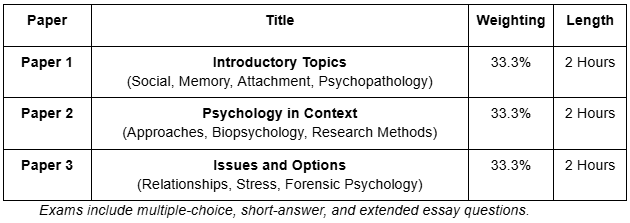
Assessment is 100% exam-based across three papers. There is no coursework, though you will conduct practical research activities in class to prepare for the exams.
Entry requirements
To succeed in Psychology, you need strong literacy skills for essay writing and a good grasp of Science and Maths (at least 10% of the marks are based on mathematical skills).
-
Standard Entry: 5 GCSEs at grade 5 or above.
-
Subject Specific: A Grade 6 in English Language and a Grade 6 in either Mathematics or Science is highly recommended.
Where can Psychology take you?
Psychology is highly valued by universities and employers because it develops analytical thinking and scientific research skills. It is an excellent choice for careers in:
-
Healthcare & Science: Clinical Psychology, Nursing, Medicine, and Neuroscience.
-
Law & Public Service: Policing, Probation, Social Work, and Criminology.
-
Business & Education: Human Resources, Marketing, Management, and Teaching.
Subject compatibility
Psychology is a "bridge" subject that pairs well with both Sciences (Biology, Chemistry) and Humanities (Sociology, History, English, Law)
Recommended reading
For prior reading for AQA A Level Psychology, you should focus on engaging with general psychology books, classic studies, and core textbooks to build a foundational understanding and interest in the subject.
Core Textbooks (Optional Pre-reading)
While not essential before starting the course, familiarising yourself with potential textbooks can be helpful. The most popular student-friendly option is:
-
AQA Psychology for A Level Year 1 & AS by Cara Flanagan et al. (Illuminate Publishing). Reading the first topics, such as Approaches in Psychology and Attachment, can give you a head start.
Wider Reading and Engaging Books
These books offer fascinating insights into psychological concepts and case studies, perfect for developing a deeper interest beyond the syllabus:
-
Opening Skinner's Box: Great Psychological Experiments of the Twentieth Century by Lauren Slater: Explores the motivations and methods behind famous studies in an engaging narrative style.
-
The Man Who Mistook His Wife for a Hat by Oliver Sacks: A collection of real-life clinical tales that explores neurological disorders and the human mind.
-
The Lucifer Effect: How Good People Turn Evil by Philip Zimbardo: An in-depth look at social psychology, particularly the Stanford Prison Experiment and situational influences on behaviour.
-
Thinking, Fast and Slow by Daniel Kahneman: An exploration of cognitive psychology, decision-making, and how the brain processes information.
-
Bad Science by Ben Goldacre: Critiques questionable claims, which helps develop the critical analysis skills needed for evaluating research in A Level psychology.
Other Resources
-
TED Talks: Watch talks by psychologists like Steven Pinker or Philip Zimbardo to gain exposure to different ideas and research areas.
-
Websites: Explore resources like Simply Psychology or Tutor2u for overviews of key theories and studies.
-
Podcasts/Radio: Listen to psychology-focused content on platforms like BBC Radio 4 (e.g., "All in the Mind") or university-produced podcasts.
Engaging with these resources will not only prepare you for the AQA A Level course but also help you develop the independent study skills valued by universities.