
CHEMISTRY
Why choose Chemistry?
Choosing A Level Chemistry is an excellent option if you are curious about how the world works at a fundamental level and enjoy solving problems through logical thinking and experimentation. Chemistry helps you develop a deep understanding of matter, from the structure of atoms and molecules to the reactions that drive processes in living organisms, industry and the environment. You will learn to think analytically, handle data with confidence and apply mathematical skills to real scientific contexts – all abilities that are highly valued by universities and employers.
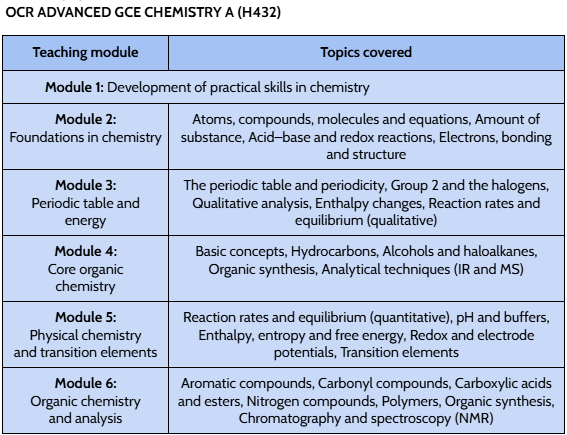
A Level Chemistry is both challenging and rewarding, combining theory with practical work. In the laboratory, you might investigate reaction rates, identify unknown substances, synthesise compounds or analyse the energy changes involved in chemical reactions. As your knowledge grows, you will see how Chemistry underpins major real-world issues such as developing new medicines, creating sustainable materials, tackling climate change and improving energy storage and production. Studying Chemistry equips you with strong problem-solving, practical and numerical skills that keep a wide range of career options open.
Chemistry works especially well with:
-
Biology (medicine, biochemistry, pharmacology)
-
Physics (materials science, engineering)
-
Maths (physical chemistry, data analysis)
-
Geography (environmental and atmospheric Chemistry)
This makes Chemistry A Level a highly flexible and respected choice when applying for a broad range of university courses and future careers.
 Entry requirements and expectations
To study A Level Chemistry, students are expected to have a strong foundation from GCSE. We require a minimum of Grades 7–7 in GCSE Combined Science or a Grade 7 in GCSE Chemistry separate Science. These grades indicate that you have the scientific understanding, mathematical competence and problem-solving skills needed to meet the demands of the course.
A Level Chemistry builds significantly on GCSE work. While the content is more detailed and conceptually challenging, the biggest change is in the way you are expected to learn. You will be required to take increasing responsibility for your own progress by revisiting topics independently, practising calculations regularly, and developing confident laboratory skills. The course not only deepens your understanding of chemical principles but also prepares you well for university study through its emphasis on precision, logical thinking and independent learning.
What to expect with Chemistry at Bexley Grammar School
All of our Chemistry teachers are experienced A Level specialists, and you will be taught by two teachers across the two year course. You will have opportunities to apply to become a Science Prefect or Science Leader, take part in national Chemistry competitions such as the UK Chemistry Olympiad and Chemistry Cambridge Challenge, and attend university-style Chemistry lectures and workshops. Practical work is a key feature of the course, with regular laboratory sessions involving quantitative analysis, synthesis of compounds, investigative experiments and the use of specialist equipment. These experiences are designed to build confidence, accuracy and enthusiasm for Chemistry, while preparing you thoroughly for further study and careers in Science.
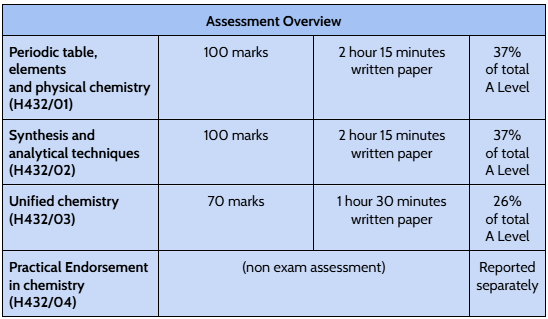
External assessments take place at the end of the two year course. Students must complete all components (01, 02, 03 and 04) to be awarded the OCR A Level in Chemistry A.
-
Additionally, there are regular internal assessments, including end of topic assessments, as well as Year 12 and Year 13 mock exams.
-
The style of the papers is varied, including multiple choice, short answer and extended answer questions.
-
There will be questions linked to practical skills in the written exams.
Experimental programme for Chemistry
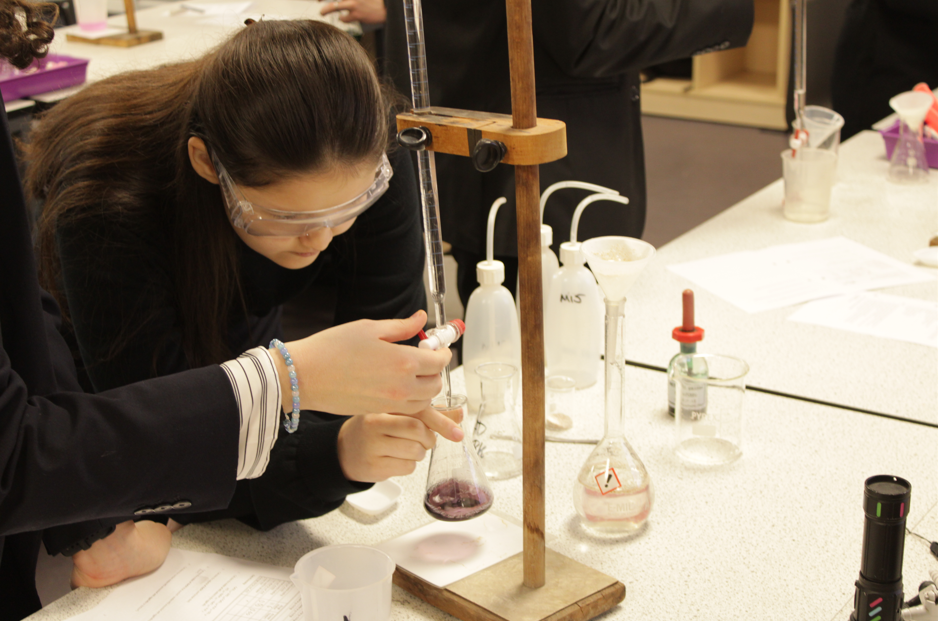
Practical work is a central part of A Level Chemistry, giving students the chance to investigate chemical principles directly. Through hands-on experiments, students explore reaction rates, equilibrium, redox processes, organic synthesis, and analytical techniques, developing a deeper understanding of chemical concepts while building essential laboratory skills.
Students gain experience in planning and designing experiments, using and handling equipment safely, recording and interpreting data, and evaluating methods. They also develop independence, problem-solving abilities, and critical thinking – skills that are vital both for exams and for further study in Science.
OCR A requires students to complete a minimum of 12 core practicals during the course. Although the Practical Endorsement is reported separately from the A Level grade, it demonstrates competence in key laboratory techniques and supports success in written assessments, where questions frequently draw on practical experience and data analysis.
Enrichment Opportunities
-
Senior Science Society
-
Medicine Society
-
Educational trips such as Chemistry in action, analytical technique masterclasses.
-
Lectures and workshops at top universities.
-
National competitions such as Olympiad, Cambridge Challenge and RSC Analyst competition
-
Science leadership roles.
-
Interview practice.
-
Support with university entrance exam (e.g. UCAT)
Further study
There are numerous career pathways open to students who study Chemistry. These include medicine and healthcare, dentistry, pharmacy, chemical and materials engineering, forensic science, environmental science, research and development, and the pharmaceutical industries, to name but a few. A strong background in Chemistry is also increasingly valuable in wider sectors such as finance, policy, education and technology, where analytical thinking and data-driven decision-making are essential.
You should note that the study of Chemistry both at A Level and at degree level develops key skills that are highly sought after by employers, including logical and deductive reasoning, high-level problem-solving, practical and analytical skills, and the ability to interpret complex data. As a result, Chemistry is a highly respected and versatile subject choice, regardless of your eventual career destination.