
BIOLOGY
Why choose Biology?
Choosing A Level Biology is an excellent option if you are curious about the living world and want to develop skills that are highly valued both at university and beyond. Biology encourages you to ask thoughtful questions, make careful observations, analyse evidence critically and solve complex problems. Through your studies, you will explore how living organisms function at every level, from the structure of cells viewed under a microscope to the interactions between species in ecosystems and the processes that drive evolution.
A Level Biology is a practical and wide-ranging subject. You might investigate enzymes in the laboratory, study plant growth in controlled conditions, explore human physiology, or examine how diseases affect populations. As your understanding develops, you will see how biological knowledge helps us tackle real-world challenges such as protecting the environment, improving human health, and ensuring sustainable and secure food supplies. Studying Biology not only deepens your understanding of the natural world, but also equips you with analytical and practical skills that open doors to a wide range of future careers.
Biology works especially well with:
-
Chemistry (medicine, biochem, pharmacy)
-
Psychology (neuroscience, behaviour)
-
Geography (environmental and ecological topics)
-
Maths (data analysis, statistics)
This makes it flexible when choosing university courses.
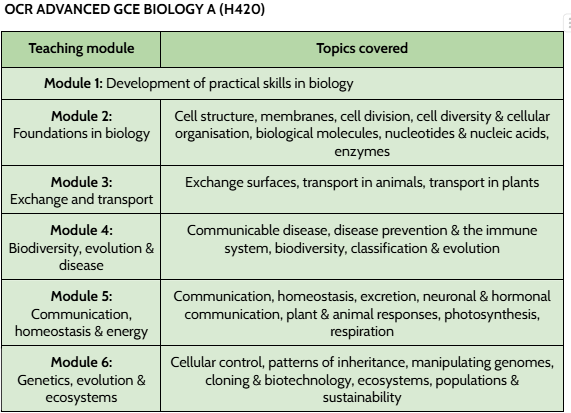
Entry requirements and expectations
To study A Level Biology, students are expected to have a strong foundation from GCSE. We require a minimum of Grades 7–7 in GCSE Combined Science or a Grade 7 in GCSE Biology separate Science. These grades demonstrate that you have the scientific understanding and mathematical skills needed to cope with the demands of the course.
A Level Biology builds significantly on what you have studied at GCSE. While the subject content is more challenging and conceptually demanding, the key difference lies in the way you are expected to learn. You will be required to take greater responsibility for your own progress by reviewing material independently, developing effective study habits, and engaging actively with practical and theoretical work. The course is designed not only to deepen your biological knowledge but also to prepare you for university study, both academically and in terms of the independence and self-discipline expected of you as a learner.
What to expect with Biology at Bexley Grammar School
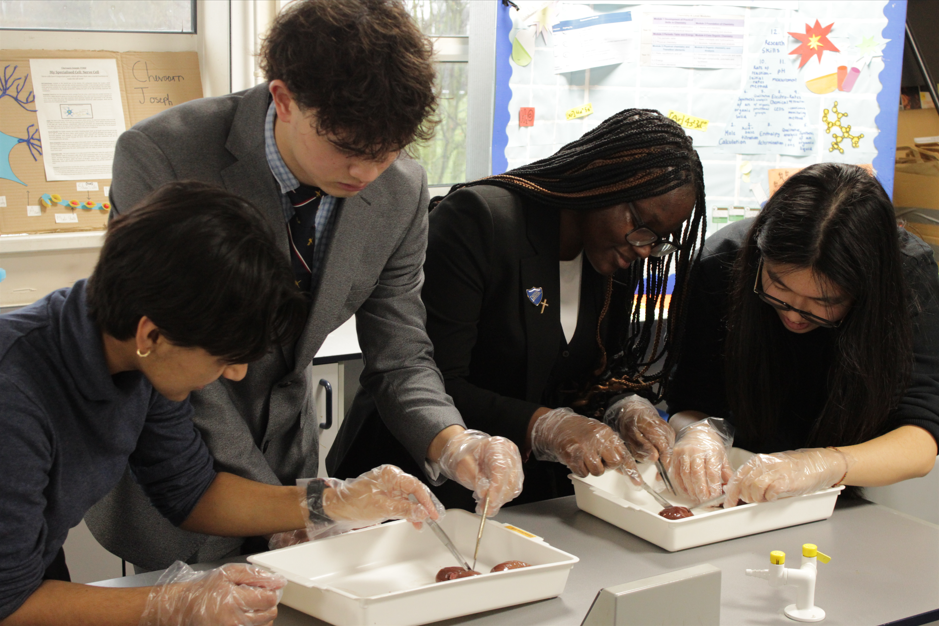
All of our dedicated Biology teachers are experienced in teaching A Level. You will have two teachers delivering the content over the two years. You will have the opportunity to apply to be a Science Prefect or Science Leader, to take part in national Biology competitions, to attend Biology lectures and surgical workshops and to carry out practical investigations and field work ranging from the use of microscopes, to dissections, to sampling biodiversity.
External assessments take place at the end of the two year course. Students must complete all components (01, 02, 03 and 04) to be awarded the OCR A Level in Biology A.
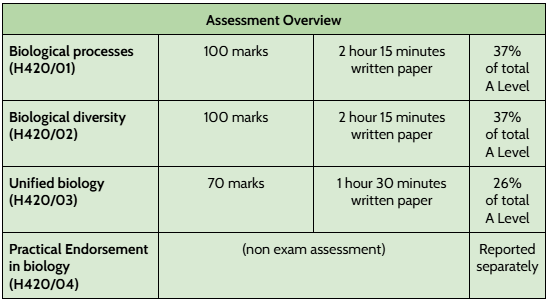
-
Additionally there are regular internal assessments, including end of topic assessments as well as Year 12 and Year 13 mock exams.
-
The style of the papers is varied including multiple choice, short answer and extended answer questions.
-
There will be questions linked to practical skills in the written exams.
Practical skills in Biology
Practical work is a central part of A Level Biology and gives students the opportunity to explore living systems first-hand. Through hands-on investigations, students use microscopes, carry out enzyme experiments, study plant and animal processes, and analyse physiological responses. These activities help deepen understanding of biological concepts while developing essential scientific skills.
Students will gain experience in planning and designing experiments, handling equipment safely, recording and analysing results, and evaluating methods. They also learn to work independently, solve problems, and think critically about evidence – skills that are invaluable both in exams and in further study.
OCR A requires students to complete a minimum of 12 core practicals over the course. While the Practical Endorsement is reported separately from the A Level grade, it demonstrates competence in key laboratory techniques and underpins success in written assessments, where questions often draw on practical experience and data analysis.
Enrichment Opportunities
-
Ecology based Fieldwork
-
Senior Science Society
-
Medicine Society
-
The Dissection Guy workshop
-
Biology Olympiad competitions
-
Biology in Action
-
Science leadership roles.
-
Interview practice.
-
Support with university entrance exam (e.g. UCAT)
Further study
There are numerous career paths that can be followed as a Biologist. These include involvement with medicine & health care, biochemical engineering, research, conservation & environmental science, education, forensic science and biotechnology, to name but a few. A solid biological background is increasingly useful in sectors such as politics and economics, where health, the environment and worldwide food supplies are huge issues.
You should note that the study of Biology both at KS5 and at degree level develops the key skills so much in demand from prospective employers, e.g. logical deductive thought processes, high level problem-solving and an ability to process large volumes of information. It is therefore a valuable option, regardless of your future prospects.